Montessori and Japanese Life Skills: A Parent's Guide
A preschool's approach should be visible in what children do each day. Can they choose a useful activity, try it themselves, move freely and ask for help? This guide explains the ideas behind our own play-based curriculum in Janakpuri and the questions worth asking when you visit.
What Does Montessori-Inspired Mean?
The Association Montessori Internationale describes learning through activity, independence and adult guidance. Children participate in discovery, with materials and surroundings suited to their stage of development.
At The Little Thinkers, that inspiration sits within our own curriculum. We combine hands-on exploration with stories, group activities and early literacy and maths. For example, sorting objects gives a child a concrete way to compare sizes before working with an abstract idea.
Parents should distinguish an inspired approach from an accredited Montessori program. Ask any school about its curriculum and teachers' training, and observe what happens in the classroom.
Hoiku and Shitsuke, in Everyday Language
Hoiku refers broadly to early childhood care and education. We use it when talking about learning and care together: relationships, play, communication and feeling comfortable enough to participate.
Shitsuke, in our school context, means gently practising everyday habits. Greeting someone, waiting for a turn, caring for shared materials and putting an activity away are examples. Children need repetition, patient demonstrations and encouragement as they learn.
Japan's MEXT Course of Study for Kindergarten (2008, PDF) discusses play-centred learning, relationships, movement and daily habits. It is a reference for these ideas, rather than a claim that our Indian preschool follows Japan's national curriculum.
Learning by Doing Includes Physical Development
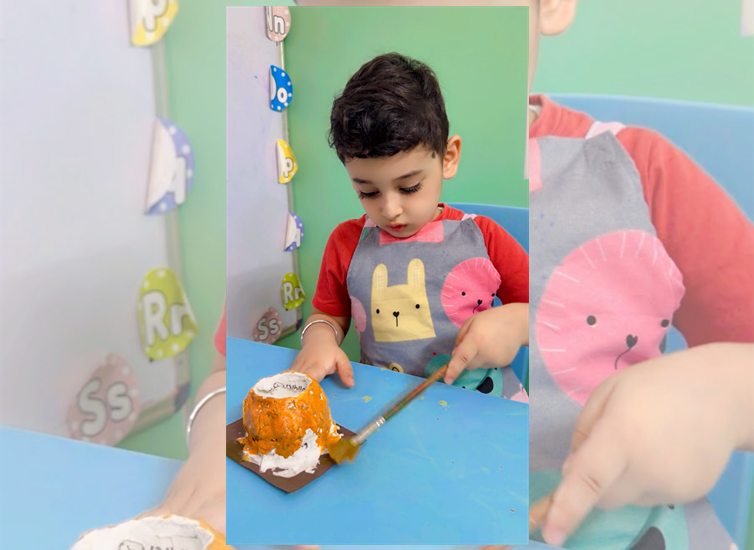
Our school opened in 2025 with a vision to give children more than books and classwork. Outdoor play, yoga, dance and practical activities make movement part of the day. Using a brush, handling objects, balancing and tidying up all give children ways to participate with their bodies as well as their words.
Progress can look different for each child. One child may start asking for help; another may join a group activity or try a task again. These are useful things to discuss with teachers, without comparing every child against the same timetable.
Choosing an Approach for Your Child
Montessori-inspired learning often gives more space to hands-on choices and repeated practice. More teacher-directed classrooms may use a shared lesson and the same task for the whole group. Many preschools blend approaches. The label alone will not tell you how warmly a teacher responds or how well the routine fits your child.
Ask These Questions on a School Visit
- How many children are with one teacher, and how does the teacher support a child who needs more time?
- Can I see an example of independent play, a guided activity and an outdoor or movement session?
- How do you help children settle in, share materials and handle frustration?
- How do parents receive updates, and how are authorised pickups verified?
- What are the current fees, transport arrangements and daily timings?
Explore The Little Thinkers
Our preschool groups have 8-10 children. Explore Playgroup (2+), Pre Nursery (3+) and Nursery (4+), or read about After School learning and enrichment.
Founder Sumita Lamba holds an MA in Psychology, an M.Ed and an M.Phil in Education. Our campus has CCTV coverage, and transport is available; reception can confirm routes and charges. Read the parent FAQs or our Janakpuri school-visit checklist before meeting us.